


Home
>
Curiosities from the oil mill
>
Fior di Sale: What It Is, How It's Produced in Sicily, and How to Use It in the Kitchen

Fior di Sale: What It Is, How It's Produced in Sicily, and How to Use It in the Kitchen
There is a precise moment when fleur de sel is born: the early morning hours, when the wind is calm, the sun begins to warm the surface of the salt pans, and the water evaporates slowly. In that fragile balance of heat, humidity, and still air, the purest sea salt crystals rise to the surface and form a very thin layer—an almost ethereal film that harvesters collect by hand, delicately, before it sinks.
That layer is called fleur de sel. It is not processed salt, it is not refined, it is not iodized. It is sea salt in its most immediate and fragile form: hand-harvested, without cooking, without additives, at the exact moment nature offers it.
What is Fleur de Sel: Definition and Origin
Fleur de sel—the French name that has conquered kitchens worldwide—is the superficial crust that spontaneously forms on evaporating salt pans on warm, windless days. These are sodium chloride (NaCl) crystals formed by natural evaporation, harvested before they precipitate to the bottom of the basin where they would become common salt.
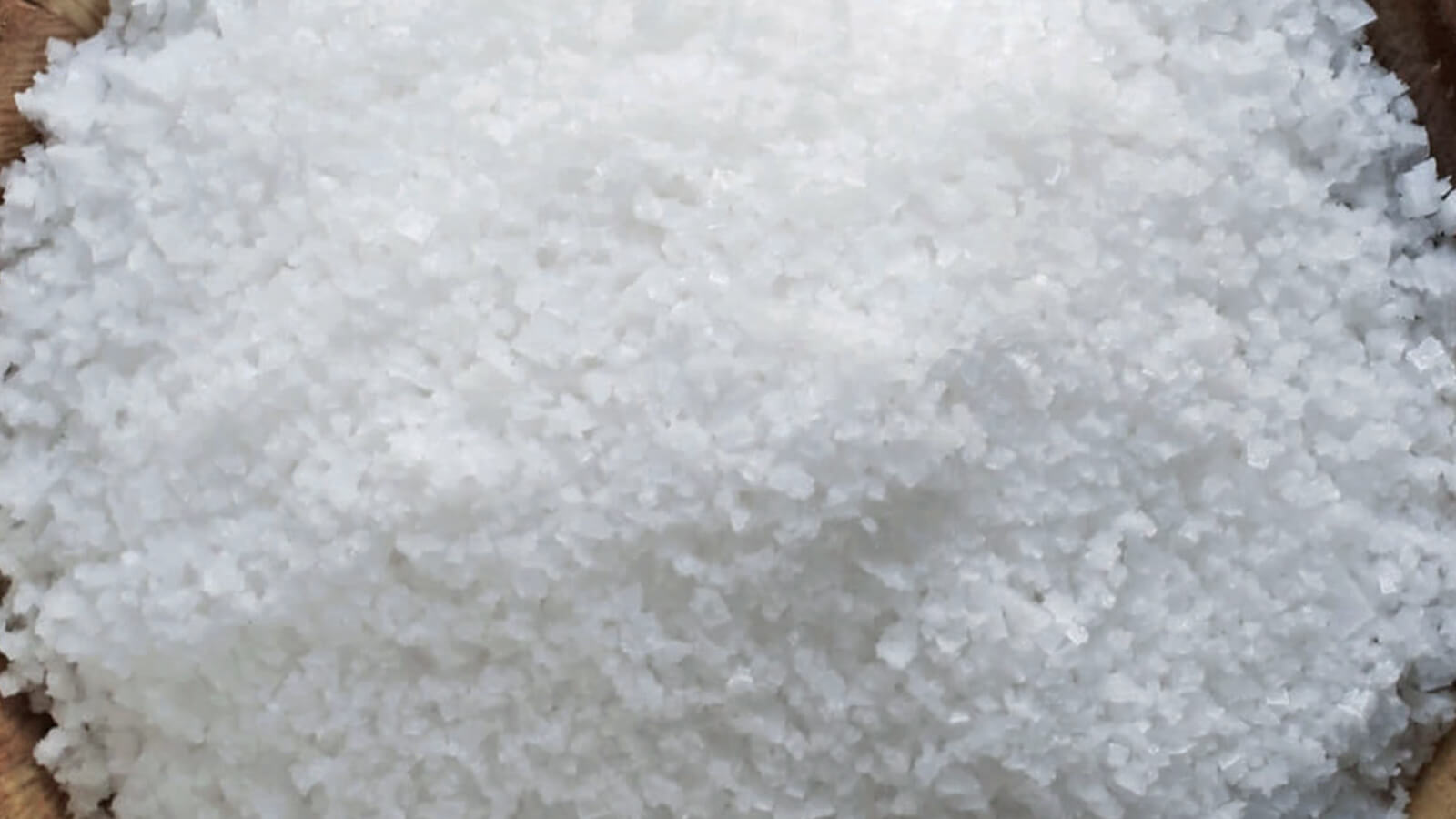
What makes it unique is its crystalline structure: irregular, flat flakes, with a large surface area relative to their weight. This morphology produces a different dissolution on the palate—not an immediate and aggressive sensation like fine salt, but a slow, nuanced, almost marine perception, with a lingering mineral note.
Fleur de sel is not simply "quality salt": it is an ingredient with its own sensory identity, which changes depending on the territory where it is produced, the composition of the water, and the nature of the salt pan seabed. Just like extra virgin olive oil—which we wrote about in our complete guide to olive oil—salt also tells the story of the land from which it comes.
Fior di sale vs fleur de sel: are they the same thing?
Yes—they are different names for the same type of product. Fleur de sel is the French name, historically used for fleur de sel produced in Brittany (Guérande) and Camargue, which has become the international reference for the category. "Fior di sale" is the Italian name. The production characteristics are the same: manual harvesting, from the surface of the salt pans, unrefined crystals.
The differences between Breton and Sicilian fleur de sel lie not in the method but in the territory: the mineral composition of the seawater, the microclimate, and the evaporation conditions produce crystals with their own organoleptic nuances.
How Fleur de Sel is Produced in Sicily
Western Sicily—particularly the coastal strip between Trapani and Marsala—is one of Europe's most suitable areas for sea salt production. The reason is the combination of long, hot summers, intense solar radiation, sirocco winds that accelerate evaporation, and Mediterranean waters with naturally high salinity.
The Trapanese salt pans are environments of extraordinary ecological richness: evaporation ponds that host flamingos, avocets, and gray herons, with historical windmills—some still functional—that pumped water between the ponds. This unique landscape is now protected as the Stagnone di Marsala Nature Reserve.
The harvesting process
Fleur de sel production is seasonal and artisanal, with essential steps that are irreplaceable:
- Preparation of the basins: The salt pans are organized into basins for progressive evaporation—seawater enters the outer basins and is gradually evaporated until it reaches the crystallization basins where salinity reaches very high levels.
- Ideal conditions: Fleur de sel forms only on days with strong solar radiation, low humidity, and no or very weak wind. If the wind is strong, the surface film breaks and sinks. For this reason, harvesting is only possible on certain days of the summer season.
- Manual harvesting: Harvesters (the "salinari") collect the crystals with a special flat blade, gently skimming the surface of the water without touching the bottom. Any wrong movement contaminates the fleur de sel with the coarser, impurity-rich bottom salt.
- Natural drying: The collected crystals are left to air dry, without cooking or artificial heating. This step preserves the crystal structure and mineral content.
- No refining: Unlike industrial table salt—which is washed, centrifuged, dried at high temperatures, and treated with anti-caking agents—fleur de sel undergoes no chemical or thermal treatment.
The yield is very low: a crystallization basin produces a much smaller quantity of fleur de sel than common salt produced at the bottom. This explains why fleur de sel is inherently more expensive—it's not a marketing issue but an economics of harvesting.
Differences Between Fleur de Sel and Common Salt
The comparison between fleur de sel and industrial table salt is much broader than it seems. It's not just about particle size or "fineness."
Chemical composition
Common table salt is almost pure sodium chloride (NaCl)—up to 99.9%—because industrial refining removes magnesium, calcium, potassium, and all other minerals present in seawater. Anti-caking agents (E536, E535) are often added to keep it free-flowing, along with artificial iodine.
Unrefined fleur de sel retains the original composition of seawater: in addition to NaCl, it contains magnesium, calcium, potassium, and trace elements in small quantities. It contains no additives. This mineral complexity contributes to its more nuanced taste profile compared to refined salt, which is simply "salty" without nuances. The same principle applies to distinguishing an unrefined extra virgin olive oil from an industrial olive oil: refining removes complexity.
Crystalline structure
Industrial table salt has uniform cubic crystals, produced by controlled crystallization under standardized conditions. Fleur de sel has flat, irregular crystals, formed by slow natural evaporation: this shape causes it to dissolve more slowly on the palate, releasing salinity progressively rather than in a single wave.
Perceived saline intensity
For the same weight, fleur de sel seems less salty than fine salt: the large, light crystalline structure occupies more physical space for the same number of grams. In cooking, this translates into more precise control over saltiness—less salt is added to achieve the same effect.
Residual moisture
Authentic fleur de sel has a slight residual moisture, perceptible to the touch. This is a sign that the crystals have not been dried at high temperatures, thus preserving their structure and mineral profile. Completely dry fleur de sel has almost always been treated.
If you want to discover other types of Sicilian sea salt—from coarse-grain sea salt to oregano-flavored salts—you can find the entire range at Segreti di Sicilia.
How to Use Fleur de Sel in Cooking
Fleur de sel has a fundamental rule: it should be used raw, at the moment of serving. Not during cooking.
The reason is technical: heat melts and redistributes the crystals, eliminating the structure that makes fleur de sel interesting. If you add it to a pot or pan during cooking, you will simply get salt—good salt, but without the specificity that distinguishes it. Its value lies in the crunchy texture perceived on the bite and the slow dissolution on the palate.
Rules for use
- Only at the end of cooking or directly on the plate: Add fleur de sel at the last second, when the food is ready to be served.
- Use your fingers, not a salt grinder: Fleur de sel crumbles gently between your fingers. A salt grinder would crush it too much, reducing it to granules and losing some of its characteristic texture.
- Moderate dosage: Its intensity is different from common salt. Start with a little and adjust to taste.
- Not on pasta or in cooking water: To salt pasta water, use coarse sea salt. Fleur de sel would be ruined by prolonged cooking.
Pairings
Fleur de sel works best where you want it to be perceived as a distinct element—not as "background saltiness" but as a recognizable finishing note. Some classic and less obvious pairings:
Grilled meats and roasts: A pinch of fleur de sel on a steak just off the grill is one of the simplest and most effective ways to enhance the raw ingredient. The crispness of the crystal contrasts with the tenderness of the meat.
Salt-baked or oven-baked fish: On a freshly baked sea bass fillet, seared tuna, fresh anchovies—fleur de sel enhances the marine flavor without overpowering it. For an authentic Sicilian pairing, try it with Nocellara Salvatore Cutrera: a drizzle of single-varietal oil and a pinch of fleur de sel on a freshly grilled fish is the most honest seasoning there is.
Raw and cooked vegetables: On slices of beefsteak tomato, cucumber salad, grilled zucchini. The delicate saltiness does not overwhelm the vegetable flavors.
Fresh cheeses: On burrata, stracciatella, fresh ricotta—fleur de sel adds mineral where milk brings sweetness.
Eggs: Fried or soft-boiled eggs with fleur de sel are a French culinary classic. The crunchy crystals on the surface of the freshly cooked egg change the perception of the dish.
Desserts and chocolate: Fleur de sel on desserts is not a gourmet whim: salt enhances sweet flavors by contrast. On warm brownies, caramel, dark chocolate bars—it works because it increases the perceived complexity.
Bruschetta and bread with oil: A slice of toasted bread, a generous drizzle of Sicilian extra virgin olive oil, and a pinch of fleur de sel is one of the simplest and most honest dishes in Mediterranean cuisine. An even more surprising pairing: fleur de sel and Tonda Iblea Giovanni Cutrera, whose floral and almond profile pairs perfectly with the iodic note of Sicilian salt.
Sicilian Fleur de Sel: Territory and Characteristics
The fleur de sel from the Trapanese salt pans has its own characteristics that distinguish it from Breton or Portuguese production. The waters of the Strait of Sicily have a naturally high salinity (about 38 g/l compared to 35 g/l in the Atlantic), and the presence of magnesium and specific Mediterranean minerals gives Sicilian fleur de sel a slightly more bitter and iodic note than Guérande's fleur de sel, which tends to be softer and more neutral.
The Sicilian climate also accelerates evaporation times: the harvesting season is concentrated between June and September, with the best days being those with dry heat and no wind. Quality varies from year to year depending on climatic trends—fleur de sel from a particularly good vintage has a complexity not found in standardized production.
The same territorial logic that guides the production of Sicilian olive cultivars—where climate, soil, and variety intertwine in an irreproducible way—applies to salt: Trapani is not Guérande, and this is palpable.
Segreti di Sicilia Fleur de Sel is harvested in the Sicilian salt pans and packaged without additives or treatments: 190g of unrefined sea salt, with the slight residual moisture that indicates the absence of artificial drying.
Fleur de Sel and Extra Virgin Olive Oil: The Sicilian Pairing
If there's one pairing that epitomizes the Sicilian pantry, it's this: fleur de sel and extra virgin olive oil. Two unrefined ingredients, both with a strong territorial identity, both used raw as a final seasoning.
The logic is the same: just as a single-varietal oil from Nocellara del Belice has an irreproducible sensory profile in other territories, the fleur de sel from the Trapanese salt pans brings something to the table that no refined salt can replicate. The polyphenols in extra virgin olive oil and the minerals in unrefined fleur de sel share the same philosophy: preserving the natural complexity of the ingredient instead of standardizing it.
In the kitchen, this pairing works on almost everything: grilled vegetables, raw fish, white meats, bruschetta. The principle is always the same—add at the moment of serving, raw, without cooking.
How to Store Fleur de Sel
Fleur de sel does not expire in the traditional sense—salt is a natural and indefinite preservative. But its organoleptic characteristics can deteriorate if stored improperly.
- Open or semi-open container: Unlike common salt, fleur de sel benefits from a minimum of air circulation. Keep it in a ceramic bowl or an open jar, not in an airtight dispenser.
- Away from sources of humidity: Water vapor will cause it to clump. Keep it away from the stovetop and kitchen water.
- Not in the refrigerator: The humidity of the refrigerator will quickly deteriorate it.
- Away from strong spices: Fleur de sel absorbs odors. Store it separately from chili powder, turmeric, and powerfully aromatic spices.
Frequently Asked Questions about Fleur de Sel
What is fleur de sel?
Fleur de sel is the superficial crust that forms spontaneously in evaporating salt pans on warm, windless days. It is harvested by hand with a flat spatula before it sinks, without any thermal or chemical treatment. It has flat, irregular crystals with a slow dissolution and a more complex marine note than refined salt.
What is the difference between fleur de sel and normal salt?
Common table salt is almost pure NaCl (99.9%), industrially refined, often with added anti-caking agents. Fleur de sel is unrefined, retains the natural minerals of seawater (magnesium, calcium, potassium), and has no additives. The crystalline structure is different: flat and irregular rather than cubic, which produces a slower dissolution and a more nuanced taste perception.
How is fleur de sel used?
Only raw, at the moment of serving—never during cooking. It is crumbled with the fingers directly onto the finished dish: grilled meat, fish, vegetables, fresh cheeses, eggs, chocolate desserts. Heat melts the crystals, eliminating the characteristic texture that makes it interesting.
Are fleur de sel and fior di sale the same thing?
Yes: same type of product, different names. Fleur de sel is the French name (Brittany, Camargue), "fior di sale" is the Italian name. Organoleptic differences between different productions depend on the territory and the composition of the seawater, not on the method, which is identical.
Is fleur de sel less harmful than normal salt?
Fleur de sel still contains sodium, like any other salt. It is not a diet product. The practical advantage is that, by using it raw as a finishing condiment, one tends to use less of it for the same perceived effect—the crystalline structure creates a more immediate perception of saltiness on the palate. It is not a salt substitute; it is a finishing condiment.
Where can I buy Sicilian fleur de sel?
Segreti di Sicilia Fleur de Sel is available in our online shop: 190g of unrefined sea salt from the Sicilian salt pans, without additives, with the slight residual moisture that guarantees the absence of treatments.


